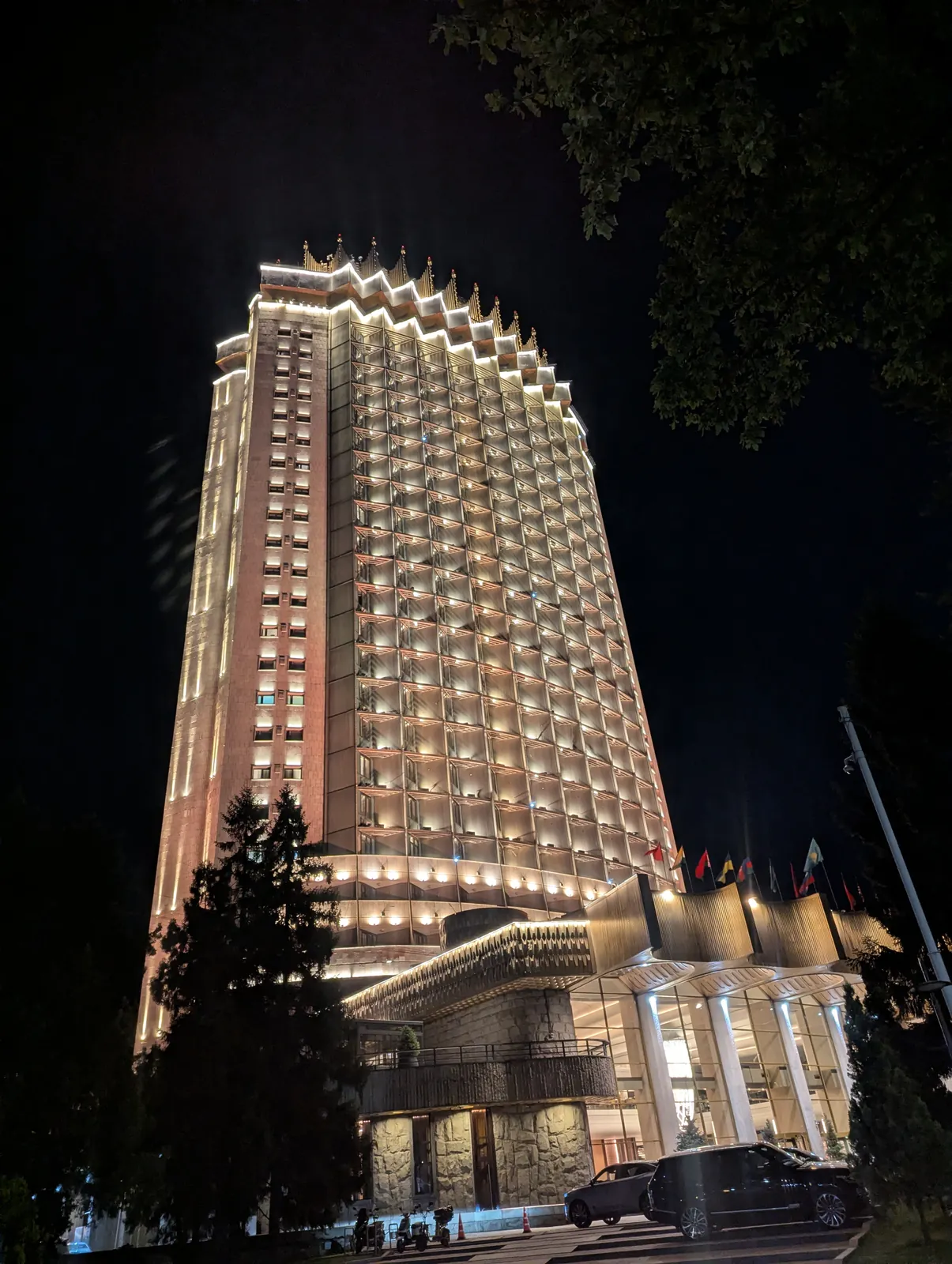
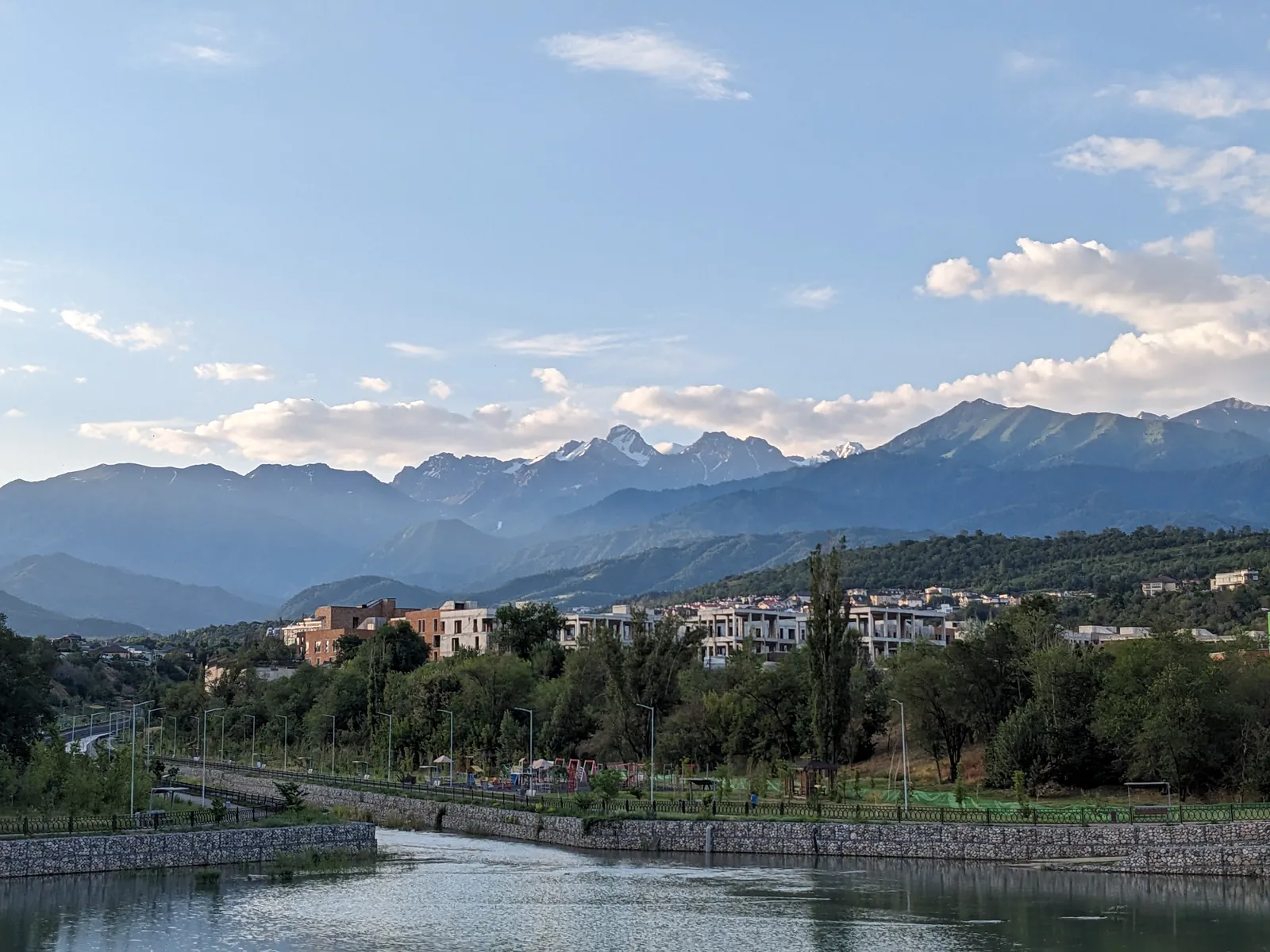
I wasn't born in Almaty, but I've loved this city since I was four years old. I spent many summers here as a child. I lived here briefly in the early 2000s. What always drew me back — even from far away — were specific things: the snow-covered peaks visible from the city streets in June, the Aport apples in September that exist nowhere else on Earth, the particular character of summer evenings in the foothills.
Then I spent two decades across New York, Singapore, Palo Alto, Manila, San Francisco, Kuala Lumpur. When I came back for good, the city had changed — but more interestingly, I had changed enough to see Almaty the way a visitor does, while still knowing what's underneath.
This is the city I'd describe to a friend who's about to spend a few days here, especially one who's already coming for the mountains, the canyons, the steppe. Most guidebooks get Almaty wrong in predictable ways. Here's what they miss.
What People Get Wrong About Almaty
The Astana question. Every other traveler I meet has been told to choose between Almaty and Astana, and most of them ask me to settle it. The answer is straightforward: if you care about modern architecture and government showpiece cities, go to Astana. For literally everything else — culture, food, mountains, walkability, the actual feeling of Kazakhstan — it's Almaty. This isn't close.
The size. Almaty officially has just under 2 million people. During weekdays the population swells to roughly 3 million as commuters arrive from the surrounding districts. Most tourists never see this because they stay inside the Golden Square — the central grid of historic streets bounded by Abay, Dostyk, Tole Bi, and Seyfullin. The Golden Square is beautiful and worth your time. It's also less than 5% of the actual city. Almaty sprawls in ways visitors rarely register.
The map confusion. Here's something most visitors find out by accident: in Almaty, "up" means south. The mountains are south, and locals orient themselves by going up toward them or down away from them, regardless of compass directions. Most local maps are drawn with south at the top because of this. Hand a correctly oriented map (north at the top) to someone who grew up here and you'll watch them rotate it without thinking.
The English question. Most foreign visitors are surprised by how much English is spoken in Almaty. Adults over thirty often speak basic English; many speak it well. Younger people frequently speak it fluently — studying abroad has been a generational ambition for two decades, and English is taught from primary school. Most restaurants have at least one staff member who can take an order in English. But here's the trap: visitors assume the rest of Kazakhstan is similar. It isn't. Outside Almaty and Astana, English drops off quickly. Plan accordingly if you're heading further afield.
The languages underneath. Almaty is ethnically mixed — the two largest groups are Kazakhs and Russians, with smaller populations of Uyghurs, Koreans, Tatars, Uzbeks, and others. The day-to-day lingua franca of the city is Russian, a legacy of the Soviet period when Kazakh was actively suppressed. Kazakh use is growing, signage is bilingual, but most casual interactions still happen in Russian. Here's the move worth making: before you come, learn four phrases in Kazakh. Salemetsiz be (hello). Rakhmet sizge (thank you). Sauboliniz (goodbye). Kalaisiz (how are you). Use them and you'll watch faces change. Even ethnically non-Kazakh locals — Russians, Koreans, Uyghurs — warm up to visitors who make the effort, because the effort signals respect for where they're standing rather than treating Kazakhstan as a generic post-Soviet country.
The welcome. Kazakhstan was treated as a colony for most of the Soviet period — local language, culture, and identity actively suppressed. The legacy of that is a national openness toward foreigners that genuinely surprises people. Most Kazakhs are curious about and welcoming of visitors. Xenophobic incidents exist but are rare and tend to be directed at specific groups rather than Western visitors. The dominant emotional baseline is hospitality.
The harshness elsewhere. The other thing visitors get wrong is assuming the rest of Kazakhstan is like Almaty. It isn't. Life outside the major cities is harder. People are less fluent in languages. Tourism infrastructure is sparser. The reality of life across the country's enormous geography is more difficult than the cosmopolitan veneer of Almaty suggests. This isn't a warning — it's a calibration.
Almaty means "place of apples" in Kazakh (alma = apple). The city's older Soviet-era name was Alma-Ata — "father of apples." Either way, the name reflects something most visitors never learn: the foothills around this city are the genetic origin of the cultivated apple. Every Honeycrisp, every Gala, every Granny Smith on Earth traces back through DNA to Malus sieversii — a wild apple species that still grows in the Tien Shan slopes above Almaty. You're walking through the global birthplace of one of the most-eaten fruits in human history. Most guidebooks don't mention this. It's worth knowing as you eat your way through the city.
What's Actually Worth Doing
Almaty's old city is genuinely walkable and should be explored on foot. The pace of the streets, the trees, the irrigation channels running along most sidewalks — these don't make sense from inside a taxi. A few specific recommendations from a long list:
Get out for a hike. It's a sin to be in Almaty and not go up into the mountains, even briefly. You don't need anything extreme. From Medeu — itself a 20-minute drive from the city centre — you can do two-hour round-trip hikes to Karakungey or Serkebay that give you real mountain scenery without commitment. If even that's too much, walk the Terenkur health path along the Malaya Almatinka river right through the city. The trail follows the river through urban green space and feels nothing like a city walk.
Green Bazaar. The Soviet-era heir to the Silk Road markets. Beautiful, chaotic, worth photographing. One insider note: don't buy much at the stalls immediately inside the main entrance — they're priced for tourists. Walk to the pavilion on the left, go downstairs, and you'll find the same goods at roughly local prices. The presentation is less polished. The merchandise is identical. For the view, grab a coffee at Bowlers Coffee and ask for a Dutch pancake — the café overlooks the bazaar from above.
Eat an Aport apple, if your timing is right. This is specifically an Almaty thing. The Aport is a regional apple variety — large, fragrant, with a distinctive complex flavor that doesn't translate to any commercial cultivar — that grows best in the Almaty region and is at its peak in September and October. If you're here in autumn, find them at the bazaars or roadside fruit stalls and try one. The connection between this apple and the city's identity (and name) becomes immediate when you taste it. Outside that two-month window, you'll have to settle for the global apple varieties — fine, but not the same.
Museum of Musical Instruments. Small, distinctive, and home to an extraordinary collection of Kazakh traditional instruments. Call ahead and politely ask whether a guide can play a dombra kuy (traditional Kazakh musical piece on the two-stringed dombra) during your visit. English-speaking guides aren't always available; if you have a local friend who speaks Russian or Kazakh, bring them to translate.
Almaty Museum of Art. Worth visiting for both the building (one of the city's best examples of contemporary architecture) and the contents. The permanent collection mixes modern and classical Kazakh art; temporary exhibits are well curated. The on-site café is a legitimately good coffee stop. English-speaking guides available with advance arrangement.
Rent a bike or scooter. Almaty has over 50 kilometres of dedicated bike lanes with more under construction. Most visitors don't realize this. The infrastructure is genuinely good.
Run. If you're a runner, bring your shoes. Almaty has a vibrant running culture — check the Strava heatmaps for the city and you'll find well-trodden routes through parks, river paths, and foothill loops you'd never find otherwise.
Abay Opera House. Soviet architecture at its most ambitious, performances at a genuinely high level, central location. If there's something on while you're here, go.
Take a walking tour with Dennis. An American who's lived in Almaty for over a decade and knows the city better than most locals. His English-language walking tour is the best way to spend three hours if you want context. He's also genuinely fun company.
And the list is essentially endless — the Almaty Botanical Garden, the slowly-crumbling Soviet-era apartment blocks, the Saki kurgans inside the city limits, the back rooms of the Green Bazaar, the hidden courtyards of the old quarter. Spend a few days walking and you'll find your own.
What's Overrated
A short list of places that show up on every "top 10 Almaty" list and don't deserve their default treatment:
Shymbulak in summer at peak weekend hours. The cable car ride up to 3,200m is genuinely impressive. The crowds on a July Saturday are not. Go on a weekday morning if you can. If you're coming on a weekend, just know what you're walking into — the experience is still worthwhile, but the volume of people is the cost of admission.
Kok-Tobe by cable car. The view is nice, the experience is not. The hill is overrun with tour groups. The redemption is hiking up and back via the wooded trail — quiet, scenic, and gets you the same view without the carnival.
Self-driving in Almaty. Traffic is comparable to Manila or Jakarta at peak times. Take a taxi, use the metro, or take public buses (many have dedicated lanes and move faster than cars). Driving here is not where you want to spend your mental energy.
Almaty in Winter
Most summer visitors don't realize Almaty is also a serious cold-weather destination — and not just for skiing.
Hiking in winter is genuinely good here, and in some ways better than summer. Snow cover smooths out the rough surfaces that make summer trails technical. The crowds disappear. The light is different — sharper, more honest about the landscape. With proper gear, a winter hike up to Kok-Zhailau or one of the Medeu-adjacent trails is one of the more underrated experiences in the city. I do a significant portion of my own training hikes in winter for exactly this reason.
Skiing is the other half of it. Shymbulak is a legitimate ski resort with reliable snow, a long season, and lift infrastructure that handles real skiing. The proximity is the unusual part — you can be on the slopes within 30 minutes of the city centre. The closest comparable cities with both a million-plus urban population and lift-served skiing within that radius are very few. Almaty is one of them.
Shymbulak isn't the only option, either. Several smaller resorts within an hour of the city centre — Oi-Qaragai, Akbulak, Aktas, Pioneer — offer simpler runs, fewer crowds, and lower prices. They're less spectacular than Shymbulak but better value for a casual ski day, especially for families or beginners. Local skiers each have a favorite. If you're here for any length of time, try more than one.
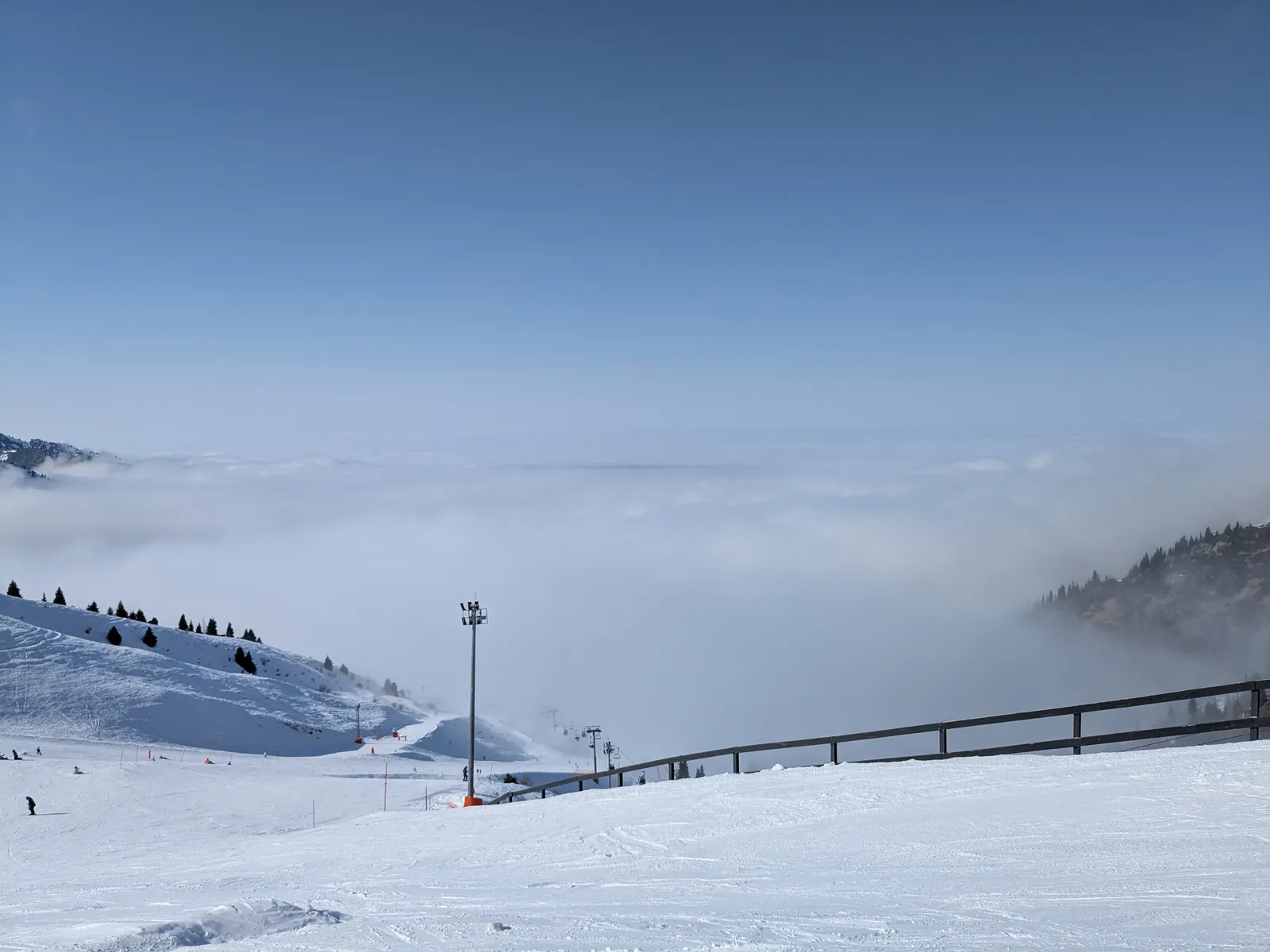
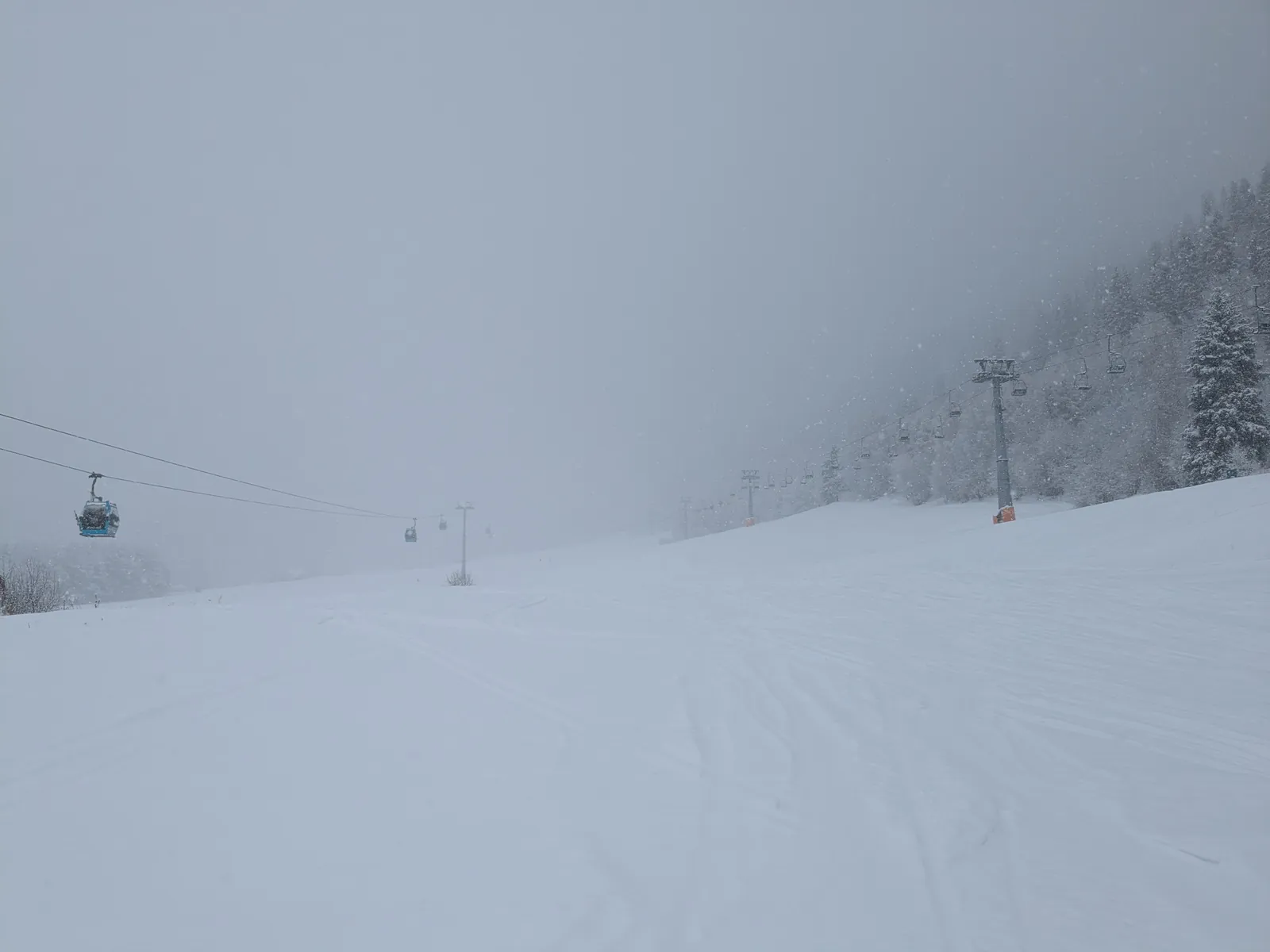
Shymbulak (left) and Akbulak (right) — ninety minutes apart, two different ski experiences.
If you're considering a winter visit, this changes the calculation significantly. The city is quieter, the air is cleaner, and what's outside the city in cold weather is genuinely extraordinary.
Walk almost any older street in Almaty and you'll pass mosaics most visitors never look up at. Soviet-era monumental art covered hundreds of building facades, courtyards, and metro stations across the city — abstract geometric panels, mythological scenes, depictions of labour and space exploration, all worked in glass tile, ceramic, and stone. The fountains do the same job at ground level: bronze sculptural compositions tucked into squares and courtyards, many still working, most ignored by the people walking past them. Once you start noticing them, the city changes. That's how Almaty hides — in plain sight, on every block, for anyone who slows down.
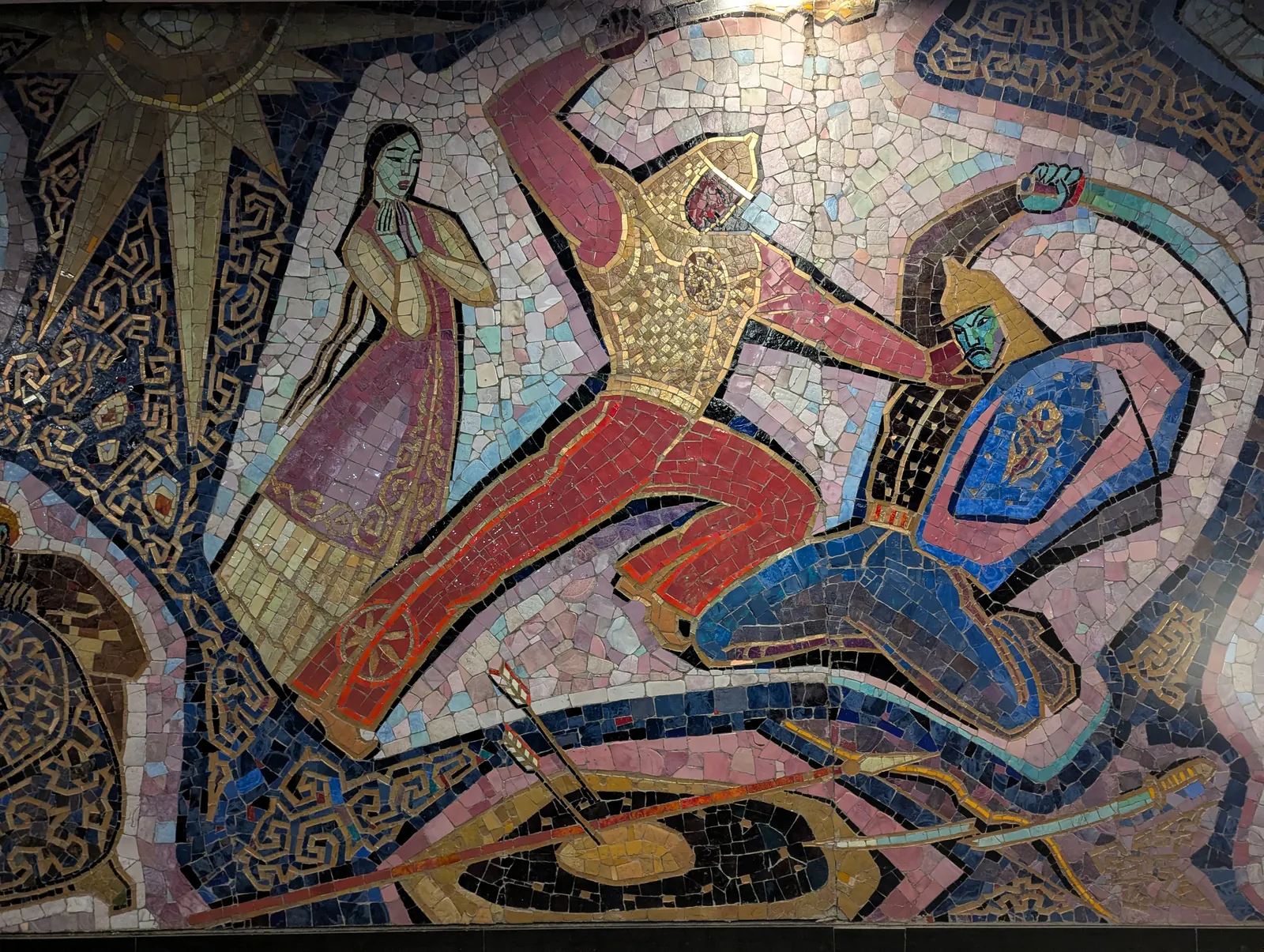
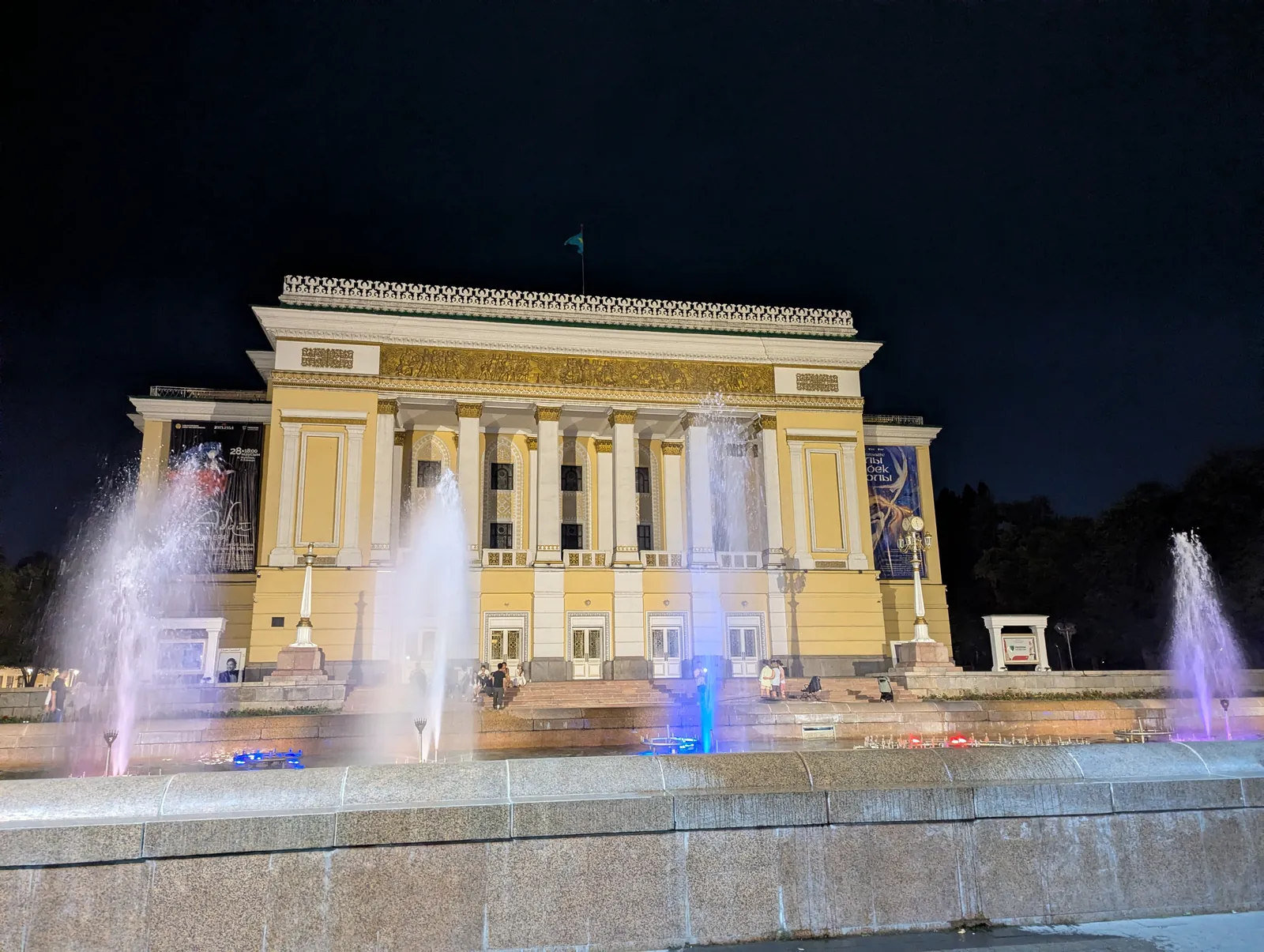
Iconic mosaic on the facade of Hotel Almaty (left), and the fountain in front of the Abay Opera House at night (right).
Why I Came Back
I lived in some of the most exciting cities in the world for two decades. I came back to Almaty specifically because of the proximity to nature. Twenty minutes from my front door, I can be on a hiking trail with no one else on it. Forty-five minutes, and I'm in a forest. A few hours, and I'm in canyons and lakes and steppe that most of the world has never heard of.
Almaty is worth your time in its own right. But the deeper reason it works as a base — and the reason it's worth more than the day or two most visitors give it — is what surrounds it. The mountains, the lakes, the canyons, the steppe. The city is the gateway. The expeditions are what you came for once you understand what's actually here.
Spend two or three days in the city. Walk it. Eat the Aport apples if it's the right month. Climb something small. Then go further.
— Anton, Almaty's 2nd best guide
Ready to go further?
Almaty is the gateway. The real trips are what's around it — canyons, lakes, steppe, the places most visitors never see. Get in touch and we'll work out where you should actually go.
Get in Touch